12月13日,驻爱沙尼亚大使郭晓梅在爱主流媒体《晚报》发表署名文章。全文如下:
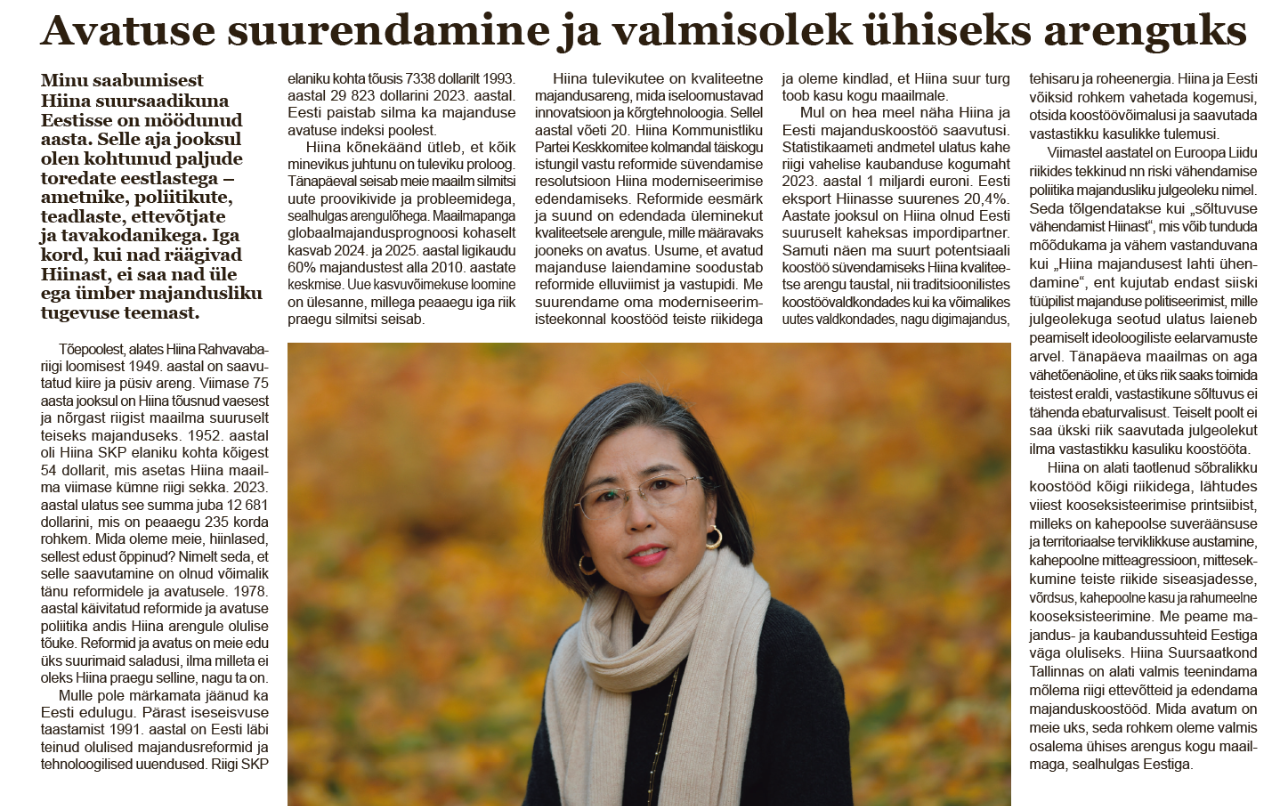
《坚持开放 共享发展》
担任中国驻爱沙尼亚大使一年来,我结识了许多优秀的爱沙尼亚人士,包括官员、政要、学者、企业家和很多普通民众。在与他们的交谈中,中国的经济实力是一个绕不开的话题。
的确,新中国成立75年来,中国摆脱了贫穷落后,取得举世瞩目的经济发展成就,成为世界第二大经济体。1952年中国人均GDP仅有54美元,属世界倒数10名之内。到2023年,中国的人均GDP已达到12,681美元,增长235倍。中国人从这一成功中学到了什么?“改革开放”。1978年开始实行的改革开放政策,为中国经济腾飞注入强劲动力。“改革开放”是中国经济快速发展的成功秘诀之一,没有改革开放,就没有今天中国的发展成就。
我也关注到爱沙尼亚的成功故事。爱沙尼亚1991年恢复独立后进行了经济改革和技术创新,人均GDP从1993年的7,338美元上升到2023年的29,823美元,经济开放指数也名列前茅。
中国有句话,一切过往皆为序幕。当前,世界正面临新的挑战和问题,发展赤字是其中之一。根据世界银行《全球经济展望》,2024-2025年,将有近60%的经济体增长率低于2010年以来的平均水平。创造和培育新的经济增长动力是几乎所有国家面临的挑战。
中国的选择是以创新和高科技为主要特征的高质量发展。中国共产党第二十届三中全会通过了《关于进一步全面深化改革推进中国式现代化的决议》,促进高质量发展,是全面深化改革的目标,“开放”是其中关键一招。我们相信,改革与开放相互促进,扩大开放有助于更好实现改革,反之亦然。在推进中国式现代化的进程中,中国将加强与各国合作,中国巨大的市场也一定会惠及世界。
我很高兴看到中爱双边经贸合作取得良好成果。根据爱沙尼亚统计局数据,2023年两国贸易总额达到10亿欧元,爱沙尼亚对华出口增长20.4%,中国连续多年位居爱沙尼亚第八大进口伙伴。同时我也相信,在中国推动高质量发展的背景下,无论在传统领域,还是在数字经济、人工智能、绿色能源等新兴领域,中爱深化合作都有很大潜力。中爱两国可以进行更多交流,寻求更多合作机会,获得更多互利成果。
然而,欧盟国家近年出现以保护经济安全为名的所谓“去风险”政策。这一政策被解读为“减少对华依赖”,听上去比“脱钩”更为温和,但本质上仍然是基于意识形态偏见将经济问题政治化,将安全范围扩大化。当今世界,一国家不可能与世隔绝,相互依存不等于不安全。相反,没有互利合作,任何国家都不可能实现安全。
中国一贯坚持在“和平共处”五项原则即“互相尊重主权和领土完整、互不侵犯、互不干涉内政、平等互利、和平共处”基础上,同各国保持友好合作。我们高度重视与爱沙尼亚的经贸合作。中国的大门将越开越大,中国驻爱使馆将竭诚为两国企业服务,促进两国经贸合作。我们愿与包括爱沙尼亚在内的世界各国一道,推动实现共享的发展。
Ambassador Guo Xiaomei's Article Titled "Keep opening up and embrace shared development" published in Estonian Newspaper Õhtuleht
On December 13th, Ambassador Guo Xiaomei's article titled "Keep opening up and embrace shared development" was published in Estonian Newspaper Õhtuleht.
The English text is as follows:
It has been one year since I arrived in Estonia as the Chinese Ambassador. During this year, I've been meeting with amazing Estonians, including officials, politicians, scholars, entrepreneurs and common citizens. Every time they talk about China, the economic strength is what could never escape from the topic.
Indeed, rapid and sound development has been achieved since the founding of the People's Republic of China in 1949. Over the past 75 years, China has evolved from weak and poor into the world's second-largest economy. In 1952 China's per capita GDP was merely $54, ranked in the bottom 10 of the world. In 2023, the number reached $12,681, nearly 235 times larger. What we Chinese have learned from this success? That is, reform and opening up. It was the reform and opening up policy introduced in 1978 that added the strength to China's development. The reform and opening up is one of our secrets without which China would not be what it is today.
I've also noticed the success story of Estonia. Right after restoring its independence in 1991, Estonia adopted significant economic reforms and technological innovations. The per capita GDP rose from $7338 in 1993 to $29,823 in 2023. Estonia also stands out in the index of economic openness.
There is a saying in China, everything in the past is the prologue for the future. Nowadays, our world is facing new challenges and problems among which is deficit in development. According to the Global Economic Outlook by the World Bank, in 2024 and 2025, nearly 60% of economies will grow below the average of the 2010s. To create new growth momentum is the task facing almost every country.
For China, high-quality economic development characterized by innovation and high technology is the way for the future. The Resolution on Further Deepening Reform Comprehensively to Advance Chinese Modernization was adopted this year during the third plenary session of the 20th CPC Central Committee. The purpose and direction of the reform is to promote the transformation towards high-quality development. Keep opening up is the defining feature. We believe that by expanding opening up, reform could be better achieved and vice versa. On our journey towards modernization we will enhance cooperation with other countries and China’s enormous market will definitely benefit the rest of the world.
I'm glad to see all the achievements on bilateral economic cooperation between China and Estonia. According to the Statistics Estonia, in 2023, the total trade volume between our two countries reached 1 billion euros, and Estonia’s exports to China increased by 20.4%. For years, China ranks the eighth largest import partner of Estonia. At the same time, I can also see the great potential for deepening cooperation against the background of China's high-quality development both in the traditional areas of cooperation and potential new areas, such as digital economy, AI technology and green energy. China and Estonia could have more exchanges, seek more cooperation opportunities and get more mutual benefit outcomes.
Meanwhile, the so-called "de-risking" in name of economic security emerged in EU countries in recent years. Interpreted as "reducing dependence on China", it may sound more moderate and less confrontational than "de-coupling" but still a typical action of politicization of economic issues with the scope of security issues expands based mainly on ideological bias. In today's world, it's unlikely for one country to be isolated from the rest of the world, mutual dependence doesn't means insecurity. On the other hand, no country could achieve security without mutual benefit cooperation.
China has always been pursuing friendly cooperation with all countries on the basis of Five Principles of Coexistence, i.e., mutual respect for sovereignty and territorial integrity, mutual nonaggression, mutual noninterference in internal affairs, equality and mutual benefit, and peaceful coexistence. We attache great importance to the economic and trade relations with Estonia. The Chinese Embassy in Tallinn is always ready to serve the enterprises from both countries and promote bilateral economic cooperation. With the door open wider and wider, we are ready to embrace shared development together with the rest of the world, including Estonia.